Date: Saturday, May 30, 2015 11:00 am to 5:00 pm
Location:
Northwest School of Wooden Boatbuilding
42 Water Street, Port Hadlock, Washington State

Location:
Northwest School of Wooden Boatbuilding
42 Water Street, Port Hadlock, Washington State


Sabtu, 19 Maret 2016
Idea 19 an Italian Variation of our TLC19
In late 1988 I was commissioned by Nebe Boats in Cape Town to design a 19ft trailer-sailer of very modern image and capable of handling the very robust sailing conditions common to the Cape of Good Hope. The result was the TLC 19, a speedy and capable little boat with fractional rig, fine bow, long waterline and scoop stern. It also had transom-hung rudder and swing keel or fixed wing keel options.
The TLC 19 hull plug later became the hull for Anthony Stewards boat for his circumnavigation. Anthonys epic voyage was completed in 1993 and to this day nobody else has accomplished his feat of sailing an open boat around the world. The endurance required to sail that distance and for that length of time in a tiny boat without cabin, sailing through whatever conditions nature could throw at him, is incredible to even consider.
Another version of the TLC 19 is being built in Italy and can be home-built from strip-wood construction methods. It has been developed by Christian Pilo and uses our hull but a different deck, rig and interior. It is named the Idea 19 and has proven to be a speedy and capable little cruiser/racer. More information is also available on the website of Nautikit, our Italian agents.
To see more of our designs, please visit our main website at http://dixdesign.com/
or our mobile website at http://m.dixdesign.com/ .
Read More..
 |
| TLC 19 sailing on False Bay |
 |
| Anthony Steward arrives home after circumnavigating. |
 |
| Idea 19 sailing in Italy. |
or our mobile website at http://m.dixdesign.com/ .
Kamis, 17 Maret 2016
Boat of the week 9
 Shell never float.
Seen at the Northwest School of Wooden Boat Building in Port Townsend.
A boat in two halves. This is the jig that students use to practise their skills in carvel and clinker (lapstrake given that its in the US) construction.
It emphasises the differences in the two techniques extremely well. The carvel side has stringers to which the frames are then bent (left of picture). On the clinker side the planks are shaped around the forms and the the ribs bent in afterwards (right of picture).
 Ive never done this so I speak out of ignorance and conjecture but...
With traditional carvel construction the outside of the hull seems to be two steps removed from the lofted shape. The stringers are bent around the moulds (one step) then the frames are bent around the stringers (two steps). Then the planking is bent around this. And must then be faired. Its a lot of work to get a smooth hull!
 In a clinker boat the planking touches the moulds. The picture one the left shows a mould on the right of frame but this is a bit deceptive. In a real boat build the mould is unlikely to be left in during planking. Though it would keep the shape of the shape of the boat and they could be removed one by one as the boat is timbered out (frames or ribs installed).
 All that aside what really appeals to me about clinker is the structural redundancy (is that a term?) of it. All those (over)laps create a stiff, strong hull. Add in the ribs and the whole shape is tied together in an almost monocoque structure. The carvel side of this hull looks like its clinging on by its threaded fastenings, its planks barely acquainted.
 I was lucky enough to be in Port Townsend on a Sunday when the shop was quiet and spent nearly two hours poring over the boats at the Northwest School but every time I saw something in a finished build I came back to the building jig to see how it was done.
What a great place to go to school.
Rabu, 16 Maret 2016
Coupeville Art of the Boat
Claire Acord is a Whidbey Island (Washington State) marine artist and watercolorist, painting mostly traditional sailing craft. She was the 2012 Port Townsend Wooden Boat Festival Artist, which has inspired her to initiate a boat event on Whidbey Island. Claire welcomes you to join her for a live update and conversation on the plans for Coupeville’s first celebration honoring the Art of the Boat…an exciting new event planned for September 14, 2013, in Coupeville, Whidbey Island, Washington. Its all about art, music, children’s events, food, literature and real boats! Learn more on the new website for the Coupeville Art of the Boat.

If youre in the neighborhood, you can meet Claire in person, during her show, this Saturday, the 13th, at Ryan and Friends Fine Art on the corner of 9th & Center, Coupeville, Washington.
There is a nice interview with Claire Acord in the Whidbey Life Magazine.
Sabtu, 12 Maret 2016
Correcting Mistakes II The Usefulness of Square Corners
When we went to put sheets of plywood on the top, er, bottom of the boat hull, they didnt really line up. WTF? It seemed unlikely that four sheets of plywood were manufactured not quite square, so we had to look elsewhere.

When we assembled the stringers with the cross beams, we had squared the pieces more or less, but little errors at the quarter inch level really add up over a 20 foot boat. We hadnt thought to square the boat up as a whole unit.
So now we measured corner-to-corner to find that there was a difference of about and inch and a half. Not giant, but enough to make the plywood fit funny on top, er, bottom. We hadnt made a rectangular boat hull, wed made a parallelogram.

That night I had a dream: We were using a come-along to square up the boat. Brilliant! Thanks, subconscious! So that morning, we grabbed my come-along and screwed big-ass eye bolts into the opposite (long) corners.

My come-along didnt go the distance, so we borrowed a hooked chain from the boat trailer and doubled it up.

We worked for a while to find the route for the chain and the come-along that when tightened wouldnt tear the building form apart.

We then started working my rusty come-along to square the boat. Kai was working the come-along originally until she realized with horror that one of the two stops that keep the ratchet from violently unratcheting broke off and fell out. She didnt want to have to explain to people for the rest of her life about that gnarly scar across her forehead so she passed on that job.

So I got to work the come-along.

After a half dozen clicks under tension the boat was approaching square. Oh wait, too far. Back off. Whoops, too little. More tension. We played that game back and forth for a while.

Until finally the two corners were within a quarter inch of each other. Once we got the sheeting on the bottom screwed and epoxied down, the boat would stay square.

Next we sheet the bottom of the hull.
Read More..
When we assembled the stringers with the cross beams, we had squared the pieces more or less, but little errors at the quarter inch level really add up over a 20 foot boat. We hadnt thought to square the boat up as a whole unit.
So now we measured corner-to-corner to find that there was a difference of about and inch and a half. Not giant, but enough to make the plywood fit funny on top, er, bottom. We hadnt made a rectangular boat hull, wed made a parallelogram.
That night I had a dream: We were using a come-along to square up the boat. Brilliant! Thanks, subconscious! So that morning, we grabbed my come-along and screwed big-ass eye bolts into the opposite (long) corners.
My come-along didnt go the distance, so we borrowed a hooked chain from the boat trailer and doubled it up.
We worked for a while to find the route for the chain and the come-along that when tightened wouldnt tear the building form apart.
We then started working my rusty come-along to square the boat. Kai was working the come-along originally until she realized with horror that one of the two stops that keep the ratchet from violently unratcheting broke off and fell out. She didnt want to have to explain to people for the rest of her life about that gnarly scar across her forehead so she passed on that job.
So I got to work the come-along.
After a half dozen clicks under tension the boat was approaching square. Oh wait, too far. Back off. Whoops, too little. More tension. We played that game back and forth for a while.
Until finally the two corners were within a quarter inch of each other. Once we got the sheeting on the bottom screwed and epoxied down, the boat would stay square.
Next we sheet the bottom of the hull.
Jumat, 11 Maret 2016
Boat of the week 8
Seen on the hard in Peter Clarkes Boatyard in West Mersea


This little yacht is just out of the water and has had its anti fouling pressure washed. Its a good opportunity to have a look at the details.
She has about 14 strakes per side and a bit of hollow near the transom creating some wine glass shape below the waterline. Other clinker yachts, like the folkboat, seem to avoid this. I imagine its quite hard to plank. The strakes are very narrow to create this hollow.
The transom is a chunky bit of timber and seems to drag slightly if the waterline paint is right. Its got a wonderful grain. If I see the boat again, out of the water, I might put a tape measure to the top plank on the transom - you dont often see boards that wide these days!

I cant quite tell where the planking ends and the keel/deadwood begins. My impression is the that the garboard strake is let in to the rabbet in the keel and that there appears to be a caulked seam.
Im guessing that the lowest seam in the photo above is from the keel to the deadwood. But Ill be happy to be corrected.

Read More..
This little yacht is just out of the water and has had its anti fouling pressure washed. Its a good opportunity to have a look at the details.
She has about 14 strakes per side and a bit of hollow near the transom creating some wine glass shape below the waterline. Other clinker yachts, like the folkboat, seem to avoid this. I imagine its quite hard to plank. The strakes are very narrow to create this hollow.
The transom is a chunky bit of timber and seems to drag slightly if the waterline paint is right. Its got a wonderful grain. If I see the boat again, out of the water, I might put a tape measure to the top plank on the transom - you dont often see boards that wide these days!
I cant quite tell where the planking ends and the keel/deadwood begins. My impression is the that the garboard strake is let in to the rabbet in the keel and that there appears to be a caulked seam.
Im guessing that the lowest seam in the photo above is from the keel to the deadwood. But Ill be happy to be corrected.
Selasa, 08 Maret 2016
A Bunch of Questions
Heres a big pile of questions that occur to me. Solutions will no doubt present themselves, but in the meantime they are open questions. Im not sweating the answers, but just want to remember to keep them in my mind for now.


Read More..
Q: How will the winch be mounted on the trailer?
Q: How will the bow eye attach? Related, how will the transom tie-downs attach?
Q: Where will the anchor(s) be stored?
Q: What about anchor line and mooring lines?
Q: Where will life vests be stowed?
Senin, 07 Maret 2016
A Collection of Photos from a Non Shantyboat River Float
I took a two-week break from building the shantyboat to float the Sacramento River. I post this here, because floating on these big rivers is where I got the craving for living on a shantyboat.
Some of my favorite times are from drifting aimlessly in our DIY raft during hot summer days. These rafts were themselves kind of shantyboats, equipped as they were with a comfy couch, a driftwood and canvas cabin, a library, a shisha pipe, houseplants, all the comforts of home. But I remember moving this giant craft with no keel around on the river with canoe paddles. Totally exhausting after a while.

This time down the river, Kai and I went a lot lighter, opting for a simple canoe and a kayak. And because I just dont know how to leave well enough alone, I was going to experiment with a DIY outrigger on the canoe for stability.

We were bringing Hazel Dog along, so (thanks to Bonnie) we had a doggy life vest for her.

Heres our mountain of stuff, including the kayak borrowed from cousin Brian and Hazel Dog in the background.

It all finds its way into the truck.

A five hour drive to Redding from where we were going to launch. Google maps shows it as just over four hours, but when you dont dare go much over 60 mph, it takes longer. Kai looks placid in this photo, but her expression belies the fact that she is terrified of my truck with good reason.

Readying our stuff at the boat launch at Turtle Bay in Redding. This was the first summer that the gianormous diversion dam at Red Bluff had been left open to allow the river to flow freely (Yay, salmon!). So unlike previous trips where we had started in Red Bluff below the dam, we could start 50 miles further upriver and see the gorgeous section of river between Redding and Red Bluff.

Kai proudly shows off her ingenious DIY shade structure she constructed out of PVC and bamboo for the kayak. It probably saved her life since she is a pale redhead that shrivels up and dies under the heat of the sun. It also made me envious and self-recriminatory that I had not spent a little time constructing a similar shade for my canoe.

The outrigger worked beautifully. An eight inch sealed PVC tube crossed with timber bamboo and secured with bike innertubes. The normally-tippy canoe was solid as a rock.
 The doggy life vest did not make Hazel happy. But she only had to wear it during our initial first few scary moments on the river and later when we encountered anything gnarly.
Shes normally pretty spry, but the tight vest left her unable to sit or curl up of jump or frolic. She just kind of stood there looking at us pleadingly. She looked a bit like the Michelin Man.
It was a simple life of reading and floating and occasionally paddling out of the way of snags and other hazards.
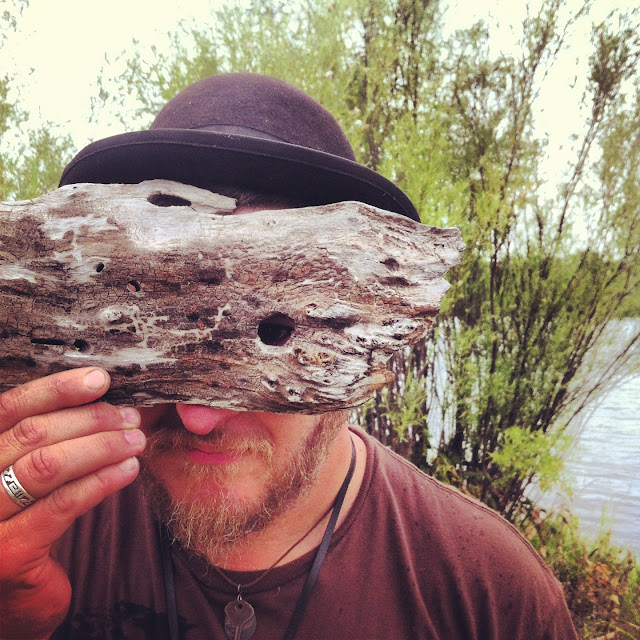
Camping along the rivers edge on sandy verges.


Fishing. We caught two little trouts. One on a treble spoon and one with creepy little helgamites. We returned them to the river.
 The helgamites came out at night and crawled over us as we were trying to enjoy our campfire. They are like hyper earwigs that were bitten by a radioactive millipede.
They do not normally calmly perch on your finger for a picture as in this photo. Normally they would be running balls-out either under a rock or up your leg into your shorts to hide.

For three nights, a storm kept us at a sweet improved DIY campsite we found along the river. We pciked lots of blackberries and ate them for dessert and breakfast.
As always, going down the river, various fisherpeople, boaters, and well-meaning fools, filled us with dread and dire misinformation about all the hazards we had yet to encounter. As it turned out, in retrospect, some of the first whitewater we encountered up near Redding was the most difficult. Whether that was because of the intensity of the river or our relative inexperience, is hard to know. But going down river, people -- and our maps -- concurred that the terror of the Chinese Rapids was the most dangerous stretch of the river.

Now true, the river was running high, and so some dangerous sections of the river were little more than riffles, and other mellow sections were dramatic, but still. Id say the section of the river around the Chinese Rapids required us to remain alert, but did not offer us the Seven Shades of Death Served Up Cold and Wet we were promised.

It was however, intensely beautiful. A volcanic lava rock canyon, twisted into a dramatic S-bend, with harrowing jagged boulders erupting out of the stream. We were too busy to take photos of the most scenic part of the trip.

Red Bluff has always been kind to us when weve rafted the Sacramento. We camped near the I-5 bridge at the north end of town near a disc golf range.


We took a little vacation from our vacation, stocking up on used books, fishing tackle, and cafe breakfast, all of which were superb in Red Bluff.
The town rekindled my fantasy of a month- or more-long writers retreat in some obscure little town, Red Bluff a definite candidate.

After Red Bluff we tackled another one of our feared hazards: the decommissioned Red Bluff diversion dam. In summers past, the gates of the dam were down, making it easy to draw water from the river for agricultural projects and forming a lake for Red Bluff summer recreation.

We only had a vague notion that it was save to pass under the dam, with some vague conflicting information from people whose job we believed was to know, park employees, river outfitters, and so on. It turned out to be less hazardous than passing under standard bridge pylons. But more dramatic, as you can see.

As weve done almost every year, we brought way too much food. But we cooked up amazing and delicious grub. There really is nothing else like the smell of bacon and onions and garlic frying outside.

Sometimes the wind would mess with my little camp stove and Id have to improvise. I called this Stove Henge.

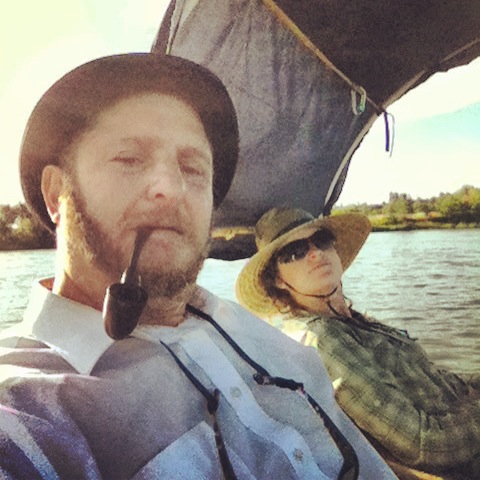
Rocking the River Amish look.


I had a little shade umbrella that Id found at the last minute, not imagining Id need it. It wasnt nearly enough. With Hazel panting like a freight train, I felt bad and gave her the shade of the little umbrella.
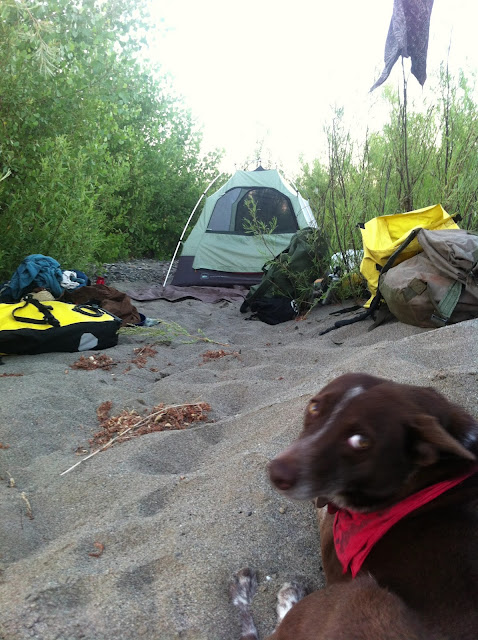
Our camp spots became strategic opportunities to hide in the shade of scant willows from the searing ball of fire in the sky.

One midday afternoon, we hid in the riverside jungle from the sun.

We camped on little islands and enjoyed the cool of the evenings.

When we stopped at Scottys Landing near Chico for a lingering lunch, unexcited to go back into the heat, we started considering alternatives. Kai the fog-loving sun-hater was reasonably comfortable under her clever shade structure. I was lethargic and dehydrated and sunburned. The projection was for many more days of even hotter weather.
This was transportation alternative number one.

This is alternative number two. I caught a ride into Chico and waited around for the Grey Dog to take me back to Redding. Meanwhile, Kai lolled around with Hazel at the swimming hole before breaking down the boats and schlepping all our shit from the boat launch to the side of the road. I got back down to Scottys with the truck and was able to pick up her and our mountain of stuff. It was still 98 degrees at one in the morning.
That night we stayed in the ridiculous cushy comfort of a cheap Chico hotel. Air conditioning and a cool shower and soft beds made a pretty sharp contrast to the previous week on the river, though not nearly as scenic.
Mission accomplished. We didnt drown and we didnt roast.
Read More..
Some of my favorite times are from drifting aimlessly in our DIY raft during hot summer days. These rafts were themselves kind of shantyboats, equipped as they were with a comfy couch, a driftwood and canvas cabin, a library, a shisha pipe, houseplants, all the comforts of home. But I remember moving this giant craft with no keel around on the river with canoe paddles. Totally exhausting after a while.
This time down the river, Kai and I went a lot lighter, opting for a simple canoe and a kayak. And because I just dont know how to leave well enough alone, I was going to experiment with a DIY outrigger on the canoe for stability.
We were bringing Hazel Dog along, so (thanks to Bonnie) we had a doggy life vest for her.
Heres our mountain of stuff, including the kayak borrowed from cousin Brian and Hazel Dog in the background.
It all finds its way into the truck.
A five hour drive to Redding from where we were going to launch. Google maps shows it as just over four hours, but when you dont dare go much over 60 mph, it takes longer. Kai looks placid in this photo, but her expression belies the fact that she is terrified of my truck with good reason.
Readying our stuff at the boat launch at Turtle Bay in Redding. This was the first summer that the gianormous diversion dam at Red Bluff had been left open to allow the river to flow freely (Yay, salmon!). So unlike previous trips where we had started in Red Bluff below the dam, we could start 50 miles further upriver and see the gorgeous section of river between Redding and Red Bluff.
Kai proudly shows off her ingenious DIY shade structure she constructed out of PVC and bamboo for the kayak. It probably saved her life since she is a pale redhead that shrivels up and dies under the heat of the sun. It also made me envious and self-recriminatory that I had not spent a little time constructing a similar shade for my canoe.
The outrigger worked beautifully. An eight inch sealed PVC tube crossed with timber bamboo and secured with bike innertubes. The normally-tippy canoe was solid as a rock.
The doggy life vest did not make Hazel happy. But she only had to wear it during our initial first few scary moments on the river and later when we encountered anything gnarly.Shes normally pretty spry, but the tight vest left her unable to sit or curl up of jump or frolic. She just kind of stood there looking at us pleadingly. She looked a bit like the Michelin Man.
It was a simple life of reading and floating and occasionally paddling out of the way of snags and other hazards.
Camping along the rivers edge on sandy verges.
Fishing. We caught two little trouts. One on a treble spoon and one with creepy little helgamites. We returned them to the river.
They do not normally calmly perch on your finger for a picture as in this photo. Normally they would be running balls-out either under a rock or up your leg into your shorts to hide.
For three nights, a storm kept us at a sweet improved DIY campsite we found along the river. We pciked lots of blackberries and ate them for dessert and breakfast.
As always, going down the river, various fisherpeople, boaters, and well-meaning fools, filled us with dread and dire misinformation about all the hazards we had yet to encounter. As it turned out, in retrospect, some of the first whitewater we encountered up near Redding was the most difficult. Whether that was because of the intensity of the river or our relative inexperience, is hard to know. But going down river, people -- and our maps -- concurred that the terror of the Chinese Rapids was the most dangerous stretch of the river.
Now true, the river was running high, and so some dangerous sections of the river were little more than riffles, and other mellow sections were dramatic, but still. Id say the section of the river around the Chinese Rapids required us to remain alert, but did not offer us the Seven Shades of Death Served Up Cold and Wet we were promised.
It was however, intensely beautiful. A volcanic lava rock canyon, twisted into a dramatic S-bend, with harrowing jagged boulders erupting out of the stream. We were too busy to take photos of the most scenic part of the trip.
Red Bluff has always been kind to us when weve rafted the Sacramento. We camped near the I-5 bridge at the north end of town near a disc golf range.
We took a little vacation from our vacation, stocking up on used books, fishing tackle, and cafe breakfast, all of which were superb in Red Bluff.
The town rekindled my fantasy of a month- or more-long writers retreat in some obscure little town, Red Bluff a definite candidate.
After Red Bluff we tackled another one of our feared hazards: the decommissioned Red Bluff diversion dam. In summers past, the gates of the dam were down, making it easy to draw water from the river for agricultural projects and forming a lake for Red Bluff summer recreation.
We only had a vague notion that it was save to pass under the dam, with some vague conflicting information from people whose job we believed was to know, park employees, river outfitters, and so on. It turned out to be less hazardous than passing under standard bridge pylons. But more dramatic, as you can see.
As weve done almost every year, we brought way too much food. But we cooked up amazing and delicious grub. There really is nothing else like the smell of bacon and onions and garlic frying outside.
Sometimes the wind would mess with my little camp stove and Id have to improvise. I called this Stove Henge.
Rocking the River Amish look.
After our few days of stormy rain, the heat wave began. I love sun. I love hot. But anything that "feels like 119 degrees" is a bit much for me.
I had a little shade umbrella that Id found at the last minute, not imagining Id need it. It wasnt nearly enough. With Hazel panting like a freight train, I felt bad and gave her the shade of the little umbrella.
Our camp spots became strategic opportunities to hide in the shade of scant willows from the searing ball of fire in the sky.
One midday afternoon, we hid in the riverside jungle from the sun.
We camped on little islands and enjoyed the cool of the evenings.
When we stopped at Scottys Landing near Chico for a lingering lunch, unexcited to go back into the heat, we started considering alternatives. Kai the fog-loving sun-hater was reasonably comfortable under her clever shade structure. I was lethargic and dehydrated and sunburned. The projection was for many more days of even hotter weather.
This was transportation alternative number one.
This is alternative number two. I caught a ride into Chico and waited around for the Grey Dog to take me back to Redding. Meanwhile, Kai lolled around with Hazel at the swimming hole before breaking down the boats and schlepping all our shit from the boat launch to the side of the road. I got back down to Scottys with the truck and was able to pick up her and our mountain of stuff. It was still 98 degrees at one in the morning.
That night we stayed in the ridiculous cushy comfort of a cheap Chico hotel. Air conditioning and a cool shower and soft beds made a pretty sharp contrast to the previous week on the river, though not nearly as scenic.
Mission accomplished. We didnt drown and we didnt roast.


.jpg)


.jpg)
.jpg)
