Pages

Tampilkan postingan dengan label 40. Tampilkan semua postingan

Senin, 14 Maret 2016

Design 1767 Aquarius 40

 Boo Hoo

We have posted about this well utilized and popular design before.  As can be found in a previous posting, various boats were built of both wood and fiberglass to this design.  For the purposes of this article lets focus on the Aquarius 40, built of fiberglass in Finland.

A writer was kind enough to send us the article found below about the design.

S&S Design #1767 - a classic yacht
Translation of an article published in the Finnish Yachting Magazine “Frisk Bris” Nr 1-2009
In the impressive list of all Sparkman & Stephens designs included in the book “The Best of the Best” Design #1767 is described briefly as follows:
Year:    1964
Client:    Various
Name/Class    Honey et.al.
Job description: R.O.R.C. aux.sloop, LOA : 39.95, DWL : 28.75, Beam : 10.04, Draft : 5.52, Type : Sloop.

R.O.R.C. means the design was adapted to the British R.O.R.C. rating rule. S&S or more specifically Olin Stephens used to analyze the rating rules for finding out what was worth doing and not doing to get a favorable rating. The other dominating rating rule at the time was the CCA rule used in the USA. The rule differences were biggest for the rigs, and therefore the rig dimensions used to be different depending on where the yacht was going to race. Also draft variations were common.

It could be mentioned that the two rating rules were soon merged into one – at an ITC meeting in London in November 1968 it was decided to replace the RORC and CCA rules with the new International Offshore Rule which contained features from both of them.

S&S had with the time built up an extensive library of completed designs which could be used as a reference for new projects, and also in this case it is obvious that an earlier design was used as a basis for #1767. In the list of S&S designs one can find #1738 having exactly the same main dimensions except for the draft which is a little more, 6.23 ft.

Because lines drawings and related calculations at the time had to be made manually it saved a lot of effort if existing information could be used with just some small modifications.

It can be pointed out that a S&S design of this age has very good performance on the wind, particularly in a blow, but does not readily surf off the wind, instead there is a tendency to rolling and broaching.

In Finland 10 yachts of GRP according to Design #1767 were built 1966…68 at a yard started up for this purpose in Hämeenlinna, and the yacht type was denoted S&S 40 by the builder.

It can be noted that this type notation already existed in the S&S list for the mentioned base Design #1738. It appears the builder’s type notation is not necessarily the same as the designer’s, and some caution is needed in this respect if only one of the notations is known. It is also possible that the as built main dimensions differ from the numbers stated in the list of designs.

The name of the new yard was Teksoglass. A company with this name already existed, but so far it had manufactured glassfiber weaves. It is likely that these weaves were used for the boatbuilding, but the yard’s history was very short, it was laid down in 1969. 3 of the yachts were sold to Finland, 5 to Sweden, and 2 to Norway.

The driving force behind this boatbuilding project was Åke Lindqvist, at the time Chief Surveyor to Lloyd’s Register in Finland. He had an active interest in offshore racing, had established contacts with S&S, and the knowledge for performing scantling calculations for the yachts. GRP was then a new and unknown material for boatbuilding, and it is likely that Lloyd’s scantling rules at the time partly built on Åke’s contributions.

An interesting detail can be mentioned here – the builders knew that air inclusions in the laminate are not acceptable, and in order to enable easy control of this transparent gelcoat was used, this made the hull translucent. The outside was then painted in a color to the owner’s choice.

The owner of the first hull was Göran Olofsson, he named his yacht BOO-HOO, Åke built the second hull for his own use and named her EVA II, and the third owner was Peter Fazer with FÅGEL BLÅ.  EVA II is nowadays in Sweden and named GRY, earlier names SCHALU and SPARK, the two others have remained in Finland. Olofsson owned BOO-HOO until 2006 when he sold her to Hans Johansson and Joakim Wilenius.

One of the Swedish yachts was named GALLANT, and she was painted light blue. The others were named GONNY, ANN-CHATRIN (later KRISTIN AF ARKÖSUND), NONCHALANT (later AXELINA), and GADFLY (later CATHENA). For the Swedish yachts the woodwork and outfitting was done by Bergviksvarvet, Bromma (near Stockholm).

The Norwegian yachts were named SIESTA and NORSEMAN, and the latter was somewhat different as she had the rudder moved aft and separated from the keel. NORSEMAN was extremely successful and won 45 prices out of 50 in IOR racing between 1967 and 1977 – an early indication of the dominating underwater concept of today. It is possible that some other of the Teksoglass-built yachts also has the modified rudder arrangement.

The Teksoglass moulds were bought in the 1970s by Turun Teräskaluste in Turku, and this manufacturer renamed the type Aquarius 40. The first hull was ready in the spring 1977. Six yachts were built, one of them has the rudder separated from the keel, and another has sailed around the world. A copy of the brochure for Aquarius 40 in German language is appended.

S&S also sold the same drawings to other clients. In Sweden Bröderna Martinsson had already 1964…1965, i.e. before Teksoglass, built 3 yachts in wood, they were named HONEY, PAVANE, and CHARLOTTA IV ( later BRILLIANT). HONEY was renamed ISADORA, and was sold to Finland, where she got back her original name. The name HONEY is mentioned in the S&S design list, and it is likely that she is the original Design #1767, although all 3 yachts were launched in May 1965, which is quite remarkable for a small boatyard.

In Denmark the Walsted yard built PAM to this design in wood 1966, she was recently bought to Finland, and has the rudder separated from the keel.

In New Zealand a wooden yacht was built 1964, she is called COTTON BLOSSOM, and is now in Ireland. Further two wooden yachts were built in Australia, one was named CORROBOREE. One was built in Hong-Kong named COLUMBINE, and two in Italy, more about them below.

S&S had a big and international clientele, and solely of this design 20 yachts were built. One wonders how Rod Stephens managed to inspect them all. He did inspection trips about once every month all over the world, and mentioned once that he had much more flight hours than aircraft captains – they have limits for this.

In the S&S list the next line after Design #1767 shows Design #1767.1, the added number means it is a slightly modified variation of the same basic design. The main dimensions are exactly the same, but the client was the Italian Navy, and the year 1965.


Two wooden yachts were built, named NAUSICA and CALYPSO. They are still in good shape, but for some reason they are not mentioned in the list of Italian Navy Sail Training vessels. This list mentions, however, two much larger two masted S&S designs, #1505 and #1505.1, length about 70 ft, and built in the beginning of the 1960s.

They deserve a short presentation.
One of them, named CORSARO II participated successfully in the Transpac Race 1961, and collected 1st price overall. She took also part in the Sydney Hobart Race 1965, both required very long sailing trips before and after the race, and this must have been remarkable experiences for officers and crew.

The other yacht is STELLA POLARE, she won the Giraglia Race in 1966, with a course record that stood 18 years. Two years later she won the Bermuda – Travemünde Race overall, this race was a predecessor to the Transatlantic.

Author:
Lars Ström
larsm.strom@gmail.com


Here is a copy of the brochure he references.


And finally here is the construction plan for the fiberglass boats.  Sorry its in such poor condition.

Read More..

Minggu, 14 Februari 2016

40 Years of Wooden Boats

Dehlia and I are in currently soaking in the deep maritime history that is Mystic Seaport in Connecticut. We are here to exhibit our little Paper Jet skiff on the 23rd Annual Wooden Boat Show. We have been here every year since first showing her in 2007, when she won the Outstanding Innovation prize. As always, she is attracting a tremendous amount of attention and we just ride along on her coat tails, happy to meet and talk with those who stop by to admire her. She is just so different from everything else around her that she has to grab a few minutes out of the day from all who come by.

This years show is something special though. It also marks the 40th year of publication of Wooden Boat Magazine, a milestone that was celebrated at a big party at Latitude 41 restaurant last night. We were rubbing shoulders with many of the major characters in the sector of the boating industry that has anything and everything to do with boats built from wood. I say "characters" rather than "players" because most of these people are indeed larger than life characters when compared with much of todays bland, washed-out and politically correct world.
Masthead from Wooden Boat Facebook page.
My direct association with Wooden Boat does not go back anywhere near 40 years but it has been nearly 20 years and I have collected the magazine from long before that. I have visited their home in Brooklin, Maine, on a number of occasions, have met many of their staff on visits to the rambling mansion from which they produce their wonderful magazines and I have had close associations with a few of them for the past 10 years or so. We have become good friends in those years. They even flew me to Maine a few years ago to be a judge in their design competition, run in partnership with the sister magazine, Professional Boatbuilder.

I have come to see this organisation as a big, close-knit family. I did not realise how big, nor how close-knit, until last nights party. All of them were introduced to us and the function of each was described. Most have worked there for a very long time. Personally, I think it is the winter snow and ice that traps them there for part of the year and the exquisite beauty keeps them transfixed the rest of the time.

In all those years I have never known who was at the head of this place that produces such wonderful inspiration to everyone who loves wooden boats and creating beautiful craft from natures original engineering materials. It was quite funny how I found out who that person is and became lucky enough to meet him.

We were sitting at a big round table with about 8 other people, some known to me and some not. Steve White, the head of Mystic Seaport Maritime Museum, was MC and had been talking for awhile when I said to Dehlia that after all these years I still didnt know who owned Wooden Boat. Hardly a minute later Steve called on John Wilson, as owner of Wooden Boat, to come to the microphone. The man sitting just two seats away from Dehlia stood up.

John told us the fascinating story of the early years of Wooden Boat magazine. He told us of his incredible naivete, optimism and hard work that launched it. It was launched at Mystic Seaport at a boatbuilding course. On the strength of just two subscriptions sold to students at that course, he had 12,000 copies printed. The rest is history.

John told us how he could never have dreamed of how his magazine would help to revitalise such a deep interest in wooden boats as it has, how it has helped to bring back to life wooden boatbuilding and restoration country-wide. John inspired us with his passion for his company, his staff and his magazines.

Never one to stand back, when open mike time came and comments were invited, I had to say my bit. That was simply to point out to John that Wooden Boat had not only had that effect country-wide but had done so all over the world. This is a close group of people who produce magazines of the highest quality and which will forever be collectors items. Personally, I never throw away any copy of either Wooden Boat or Professional Boatbuilder. Dehlia knows better than to take her life in her hands by trying to throw out any copy that she may find lying around.

These magazines are great reading and wonderful for research. I look forward to receiving them for many years to come. Happy 40th birthday to Wooden Boat.
Read More..

Sabtu, 13 Februari 2016

How to build a roller furler for under 40


Ellies home-made sub-$40 roller furler
Introduction:

There are many different types of roller furling systems. This furler is a "Wykeham Martin" or "wire luff" type.  This popular design has been in continuous use worldwide for over 100 years.  It requires a jib that has a stainless steel wire sewn into the luff, or has a "jib set flying" (a jib that does not attach to a stay).  If your jib hanks onto a fixed forestay or needs to wind around a forestay this furler wont work for you. The furler you need would be more like this one.

This furler, as illustrated below, is sized for my 15 Welsford Navigator, or any similar sized small sailboat. It is comparable to a Ronstan RF76 or a Harken 434 dinghy furler.  It can be scaled up in size and strength for larger boats by substituting a stronger eye-bolt, stronger u-bolt, upper swivel, and ball bearing thrust bearing.

Here is a test run of the furler


Origin

In issue #58 of Small Craft Advisor magazine, Kirk Gresham wrote an excellent article on how he designed and built two roller furlers for his 17 cutter Eider for a mere $40 each using bits of scrap and a few bits and pieces of hardware from a local hardware store. This saved Kirk a whopping $670 off the $750 price tag he was quoted for two furler units from a local Port Townsend chandlery. I knew from the moment I read Kirks article that I wanted to build one of his furlers too. I love building things. Id much rather build something than buy it, even if it ends up costing me more. But in this case building it saved me a bundle too. Thats a two-fer for me!

I had some questions after reading the article, but I knew Kirk attends the Port Townsend Wooden Boat Festival every year, so I met Captain Kirk at the festival. He answered all of my questions and allowed me to take some close up photos of his furlers.


Being a mechanical designer by trade, naturally I couldnt resist making some improvements to the design.  I used bronze thrust washers in place of the steel radial bearings Kirk used, and I made the spool with a core of solid hardwood instead of using a section of PVC pipe.  These two changes significantly increase the strength of the furler, make it operate more smoothly and increase corrosion resistance. I also used an ABS end cap instead of the bent aluminum strap used to contain the furling line. It looks better and does a much better job of containing the line.

So, here I present my improved version of Kirks $40 roller furler.
Click to enlarge

Making the Drum Assembly

The drum is made from an inexpensive 3" ABS drain pipe end cap available at any home center that sells indoor plumbing supplies, like Home Depot, Lowes, Grainger, etc.  The cap I used is a Mueller 2979H.  (Note: a 3" cap is actually 4" in diameter.  It caps a 3" inside diameter drain pipe).  Caps are available in a variety of sizes if you want a larger or smaller furler. You will also need a stainless steel eye-bolt. I used a 1/4" x 4" Stanley V2161, but welded eye bolts are a better choice as they are much stronger. To make the drum assembly, drill a 1/4" hole in the center of the end cap for the eye-bolt. Drill 7/8" diameter holes every 45 degrees around the outside for access to the furling line. Locate these holes so they are 1/4" below the open end of the cap.
I also drilled a series of small drain holes in the bottom of the drum.
Use locktite to secure the two nuts on the eyebolt.

Making the Spool Assembly

To make the spool assembly, first I cut two plywood disks from 1/4" plywood. The outer diameter of the disks should be just slightly less than the inner diameter of the ABS cap. We dont want the furling line to slip through the gap and jam the furler. Sandwiched between the disks is a piece of oak (or any other hard wood) that is 2" in diameter and 7/8" thick. Glue these three pieces together taking care to align them accurately. Drill a 1/4" hole through the center for the eye-bolt. Drill two more holes to match the stainless steel U-bolt legs. The U-bolt I used is a 1/4" x 1-1/8" x 3-1/2" Stanley V2193. Drill one extra hole in the upper disk for the stop knot of the furling line. Paint the spool with several coats of enamel paint. Cut and file the legs of the U-bolt flush with the nuts. Use locktite to secure all four nuts.


Assembling the unit

To assemble the unit, place the spool onto the eyebolt of the drum assembly. Then add a 1/4" stainless steel washer, your thrust bearing, and a locknut. Additionally secure this locknut by drilling a tiny hole near the end of the eyebolt and adding a cotter pin, or use Locktite (blue not red).  The thrust bearing is simply two or three 1/4" I.D. sintered bronze thrust washers. These strong, inexpensive corrosion resistant self-lubricating washers should be readily available at any good hardware store, or you can order them here. Once in a great while, apply a drop of motor oil to the thrust washers. It will soak into the porous metal and lubricate them for a long time.

A ball bearing can be used instead of the thrust washers if you prefer. They are more expensive but may operate more smoothly under high tension.  The exact size you need will depend on the diameter of your eyebolt and the space available inside your u-bolt. The style of bearing you would want is shown below, and a source for stainless steel thrust bearings in many sizes is here.  Ive tested both the thrust washers and the ball bearings on my boat and there was no noticeable difference.


Tie a stop knot in the end of your furling line, feed it through the hole in the upper disk and out through one of the holes in the drum. Spin the spool to wind up the line.

Upper Swivel

A swivel is required at the head of your jib to allow the wire luff to spin and roll up the jib.  With this type of furler you want a swivel that spins easily. I have tested three different swivels on my boat that have worked well for me.

This anchor swivel, is a good choice provided your luff tension is not too tight.  If your jib uses a jib halyard, this swivel will work for you. It is extremely strong, very inexpensive, and spins well under moderate tension.  However, since its not a ball bearing swivel, it can stick when tensioned too much.

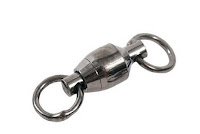
Ball bearing swivels are a better choice.  The Ronstan RF75 swivel is considerably more expensive, but is an excellent choice for larger sailboats with higher luff tensions.  And this jumbo sized (size 10) fishing swivel is an excellent choice for smaller sailboats and sailing dinghys.  It is the largest ball bearing fishing swivel Ive been able to find and works very well on my Navigator. It is rated to support up to 810 lbs.  Do not rely on this fishing swivel to hold up a mast on anything larger than a sailing dinghy.


A word about strength

Make sure you select components that are strong enough for your application. An easy and conservative way to do this is to look at the diameter of the stainless steel cable used to make your jibs luff wire.  My jib uses 1/8" cable, which has a Safe Working Load (SWL) of 352 lbs.  3/16" cable has a SWL of 740 lbs, and so on.  The SWL of each one of your components (eye-bolt, u-bolt, swivel, thrust bearing, shackles, etc) should be at least as high as that of your cables.  Youll be able to find the SWLs on the products packaging, at the manufacturers website, or with a bit of Googling. That way youll know your furler is stronger than your luff wire.

$40 furlers around the world

Click here to see Barrys UK version of this furler.
These young folks are enjoying their furler on their homebuilt catamaran
John Hows Fulmar
SailCanoeFan in Montreal  

Conclusion

This furler has performed flawlessly on my Navigator Ellie for over 5 years now, and I couldnt be more pleased with it.  If you have any feedback or if you build one of these furlers for yourself, Id love to hear about it.  Please leave a comment below.

.
Read More..

Senin, 01 Februari 2016

Design 2062 FG3 LeCompte S S 40


We have made mention of this design before. There are at least 6 different iterations of this one-tonner design built in numerous countries and in both wood and fiberglass. This particular version was a fiberglass production model built by LeCompte-Holland of Vianen, Holland. Production began in 1971. We have no record of how many boats were built by LeCompte. LeCompte later modified the design and the model was then called the ALC40.

Here are the plans.


Principal Dimensions
LOA 39-7"
LWL 29-7"
Beam 11-9"
Draft 6-6"
Displacement 17,764 lbs
Ballast 7,530 lbs
Sail Area 657 sq ft
Read More..

Kamis, 28 Januari 2016

Design 2767 40 Flybridge Motoryacht


The client for this preliminary design approached us after seeing our Pegasus design. The boat was enlarged slightly and changes were made based on his requirements, such as the addition of a flybridge. The following two general arrangement options have been proposed.


Principal Dimensions
LOA 40-0"
LWL 38-11"
Beam 12-11"
Draft 5-0"
Displacement 26,500 lbs (1/2 load)
Read More..