Pages

Tampilkan postingan dengan label make. Tampilkan semua postingan

Sabtu, 19 Maret 2016

How to Make a Displacement Hull Plane


The Bartender line of fishing boats has a reputation as a superlative surf boat. The Coast Guard has used them as rescue vessels. As doryman everywhere know, a good surf boat is double-ended and is thus less likely than a square transomed boat to broach on a following wave.


Unfortunately the double-ended hull will not plane under normal, non-surfing conditions, no matter how much power they produce. So, George Calkins designed a spray skirt for his power dories to provide more lift at the stern.


The nineteen foot Bartender in the lean-to out in the boatyard has never been outfitted with a spray skirt, as far as I can tell, but it has one now. Frank, the current owner has been frustrated that this boat tops out at 10 miles-per-hour.

 
Now, that would be just fine with me. Mentioning this to Frank made him laugh.

If this were my boat, Id have no more than a ten horsepower motor on her and be happy just puttering around. The hull drives easily and this could be a very economical package.


The boat has a 40 horsepower motor however, and a rated speed of 25 - 30 mph, which is what we are trying to achieve. The bottom had a keel hog from sitting on a poorly designed, dilapidated trailer which probably contributed to its reduced performance. Ive stressed as much of the hog out as I could, reinforced some old, tired keelson framing and re-welded the offending trailer. All in a days work for a shipwright. The spray skirt was a challenge - the hull shape aft has such a radical camber that the face of the skirt is a helix. I laminated Oregon white oak using polyurethane glue and stainless screws. Didnt have to steam bend anything, but very near.

Frank will be camping aboard this boat at the upcoming Sucia Rendezvous so Ill be able to see first hand how all this works out.


Hope you all had a better solstice than I did. You can see what I was doing on the longest day of the year.


The spray skirt meets the chine at the stern, sweeps up past the waterline about half-way, then on to touch the bow in a fair curve.


Need to clean and polish that bronze half-round for a finishing touch.....


I also prepared some salmon for the Rendezvous. John St Clair is known locally as the Salmonator. He is a prolific fish killer. (many people find it confusing that I spend so much time on the water but dont fish. With friends like the Salmonator, why should I?). Recently he gave me a 20 pound salmon that had been in the freezer for awhile. The best thing to do with a fish thats a bit past its prime is smoke it. I dont have a smoker, so I slow cooked my fish. After marinating it in a brine and sugar mixture for 24 hours, it was spiced with garlic, onion, tariyaki and sesame seeds. It was then cooked at 170 degrees F, for six hours. Dessicated fish is not photogenic, so I will forgo any pictures. Take my word for it. Its delicious!


Read More..

Sabtu, 30 Januari 2016

Organization How To Make Boatbuilding Not Suck

Boats are made of lots and lots of funny precision parts that all look more or less the same but are subtle different.  A bow skeg stringer end accidentally exchanged for a stern skeg stringer end and its all over.

The previous build day, in my excitement I threw together the dead simple building form, and assembled it wrong.  The building form is just made of 2x4s nailed together, but the boat members will be screwed and epoxied.  Theres no going back on wood parts epoxied together.  A serious error could mean having to start completely over on that member. 


So the previous build day was a lesson in the need for precision.  Before going further, I created labels for every piece of every member of the hull.  As I ripped pieces and then cut them to length, I stapled my sturdy cardboard labels directly on to the boards.


This way, when it came time to assemble, say, the starboard skeg stringer, I would only have to gather up all the pieces that said SKEG STRGR 1 (top, bottom, fore post, aft post, fore end, aft end) and bring them into the barn for assembly.


I also got a quad-ruled comp book and started taking detailed notes.  All the things youd normally scribble down on scratch paper as you were calculating angles and measurements and offsets went into the notebook.  All my little sketches of what pieces should look like before I cut them, lists of procedures, materials I needed to get, and a detailed journal of each day of work went into the comp book.


Along with a place in the barnyard to build the boat, Lawrence let us use an unused horse stall in the barn.  This made a perfect build office, a place to layout the plans, organize all our tools, and most importantly keep snacks and beer.


Having the right tool at hand when you need it, is not only convenient but can be critical during the stressful build process, especially when you are dealing with epoxy.  We spent time making sure that every tool had its own place.  This also had the benefit of making daily clean up more fun.  It felt good to do a lot of hard work and then have everything all neat and tidy at the end of the day.

Here Kai, one of my co-builders, in a goofy moment, models the first photo for our Little Shantyboat Pinup Calendar.  This also helps make boatbuilding not suck.
Read More..

Kamis, 28 Januari 2016

How to make a boat tent for under 20

Its that time of year again.  Spring Tweak time!  I know, I know, its more of a midsummer tweak.  Sorry, Im way behind schedule this year.

This years Spring Tweak is an inexpensive boom tent.
Most of the messabouts that I plan on attending this year require sleeping onboard the boat.  Unlike Sucia Islands abundant camping, many of the other destinations we like to visit have limited camping.  Saddlebag island, for instance, only has 5 campsites.  Hope Island, only 4.  Next week is the "Pocket Yacht Palooza", followed by a 4 day "Crooza" to several destinations which may or may not require sleeping onboard. Its also nice to have the option to tie up at a marina.  And theres always the possibility I could be late getting home and have to anchor who knows where for the night.  Having a boom tent onboard at all times really is a necessity. It doesnt have to be fancy in my opinion.  A quick and cheap one made from a tarp will do just fine.

So heres my version of the classic tarp-type boom tent.

After quick trip to the local Harbor Freight Tools store, I returned with this 11 x 15 foot cammo tarp for a mere $16.49, and a grommet kit for another $4.  $20 for a boom tent.  Cant beat that.

They also carry the classic blue and silver tarps too, of course, but lets be honest.  Theres really only one choice here.  Not only does cammo look good, in a far-less-tacky sort of way, but it also enables one to go Stealth Camping.  Stealth Camping, in case you are unfamiliar with the term, is the practice of arriving late at night, mooring up to someones private dock, boat, or any other no-camping area, and stealing away early in the morning before anyone realizes you were there.  I, of course, would never do such a thing ;-)

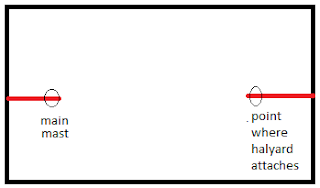
To support the tent I needed a ridgepole.  I lashed my boom and gaff together and use them as the ridgepole. My topping lift/jackstay line, and my peak halyard both prevent draping the boom tent over the ridgepole, so they get disconnected.  To support the ridgepole, I disconnect my mizzen halyard and connect it to the aft end of the ridgepole.
I measured the distance between the main mast and the point where the mizzen halyard connects to the ridgepole.  Then I cut two equal length slits in the tarp so that the distance between the slits was equal to that measurement.
That allowed me to drape the tarp over the ridgepole.

The next part is simple, as the famous sculptor Michelangelo allegedly once explained:
After marveling at Michelangelo’s statue of Goliath-vanquishing David, the Pope asked the sculptor, “How do you know what to cut away?”
Michelangelo replied “It’s simple. I just remove everything that doesn’t look like David.”
So I got out my scissors and trimmed away everything that didnt look like a boom tent.
I left some flaps at the front and rear of the boom tent so I could seal both ends off in a rainstorm.


The flaps can be rolled up and secured with a clip to keep them open, or tied down with a bit of rope to keep them closed.  I trimmed the sides even with my lower rubrail.

When I removed the tarp and laid it out flat, it looked like this.  Not an easy shape to define on a  drawing.  You can see why it really needs to be cut in-place.
 
The most difficult part about making a boom tent is coming up with a way to secure the sides.  Several methods have been employed.  Ropes can be strung under the boat from one side to the other.  Clips or snaps can be added to the gunnels to attach the boom tent to.  Ropes can be run fore-and-aft to provide an attachment point, and so on.  But the easiest, most effective, and elegant solution I have seen my friends use are sandbags.  Several small sandbags weighing about 1 lb each are fastened to the boom tent to weigh the sides down and keep them taught. They work very well and dont require a bunch of new holes to be drilled in the boat.

I didnt have enough time to make sandbags before our annual Sucia trip, so I improvised.  I used 500ml plastic water bottles instead of sandbags.  They actually worked quite well.
I drilled a small hole in the water bottle caps, tied them to the boom tent, and store the empty bottles under my front thwart.  When I need them, I simply reach over the side and fill them with seawater and screw them onto the bottle caps. The only thing I dont like about them is they tend to bounce against the hull at night, keeping me awake.  I think sandbags would be quieter so I plan on replacing them with sandbags soon.


My son Tim and I just got back from our annual Sucia Small Boat Rendezvous.  It rained off and on the entire weekend, but we were cozy and warm under this humble boom tent, using our sleeping platform. 

When we awoke in the morning, there were no signs of condensation or leaks anywhere inside the boom tent.  We were very pleased with the results.  Well worth the $20 to be sure.
Read More..